


Angelika Dusk: With 80s vibes, she talks about true connection (“Syndesi Alithini”) and how she is more than ready for Sir Rod Stewart’s concert
- Jan 19
- 10 min read

Eleni Bezirianoglou
December 9th, 2025
JENNY.GR
The pop artist talks about her return to music, opening for Sir Rod Stewart and how “the miracle of life” changed her life forever.
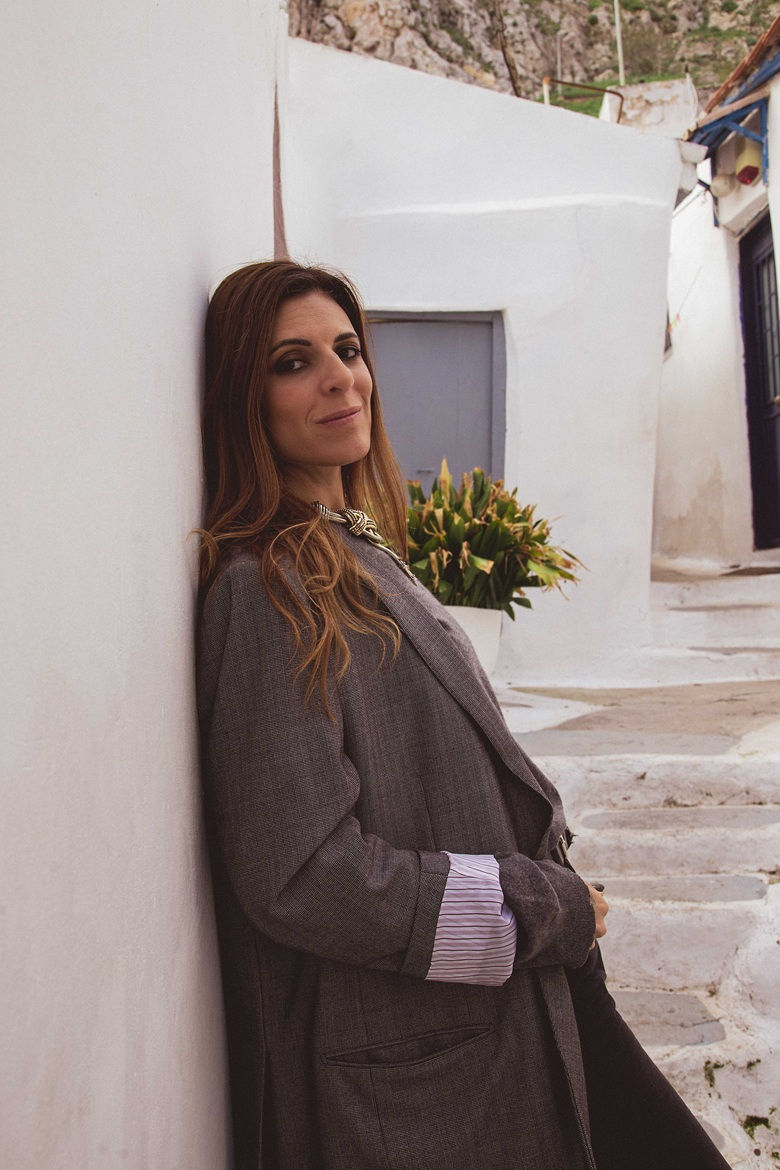
Angelika Dusk is an artist that has dared to personally rebel, coming back to the music scene with a new sound and an unshakable truth. After a pause in her career that led to her to revaluate her artistic identity and fully accept herself, she has made a strong come back with pop/rock rhythms inspired by her beloved 80s era.
What I need to mention is the effortless coolness she has, the peaceful and positive energy that embraces you from the moment she says ‘good morning’. Maybe that’s why our rendez-vous seemed more like a catch up with an old friend rather than an interview. Below, Angelika Dusk talks to JennyGR about this transition, her first song with Greek lyrics and how motherhood became her own “Miracle”.

Angelika Dusk’s sound – A bridge to the 80s
For somebody listening to you for the first time, how would you describe your sound? What is your artistic identity?
My music now is like a trip back to the 80s, pop, it takes you back to happier moments, makes you want to dance. Like Into the Groove by Madonna or some Michael Jackson songs. Of course, there are some more melancholic songs, that make me think of the beach during winter, road trips with the windows rolled down. My sound used to be darker, rockier, and I talked about gloomy topics, but now I sing about hope, love, connecting with myself and the people around me. So, I think someone would say “oh, she sounds pleasant” (laughs).
The ‘shoulds’ and the big change in her thirties
When did you know that music was your thing?
Subconsciously, I knew when I was around 3 and I danced to whatever music my parents played. Like soundtracks from Flashdance, Grease, Footloose. I would grab the microphone and pretend I was singing Diana Ross – I have a video of that. Consciously, though, I made the decision to change my life when I was 30, quite late.
Late? Is 30 considered late?
Late because I studied music at the agae of 18 when I went to the US I really liked it, but then the ‘shoulds’ got in the way. Obviously, I couldn’t be a performer or a singer, I “should” work in an office. I worked in places within the music industry, in ERT, the Athens Festival, the Greek National Opera and in orchestras in London.
“Until I was 30 and realised, I would die from depression. I was living with emptiness inside me, and I decided that this (singing) was what I wanted to do. I want to write songs. I want to sing and I want to express myself through my lyrics and my music”
So, you changed your life when you were 30. Do you feel better now?
Psychologically I feel so much better. Of course big changes are difficult. It’s difficult to change your life and for people around you to accept that you are simply changing your own life, and that you won’t be the same, because I used to live for other people when I was 30. Generally, there are ups and downs. I remember I once told my dad that “if I don’t play music, I will die”. There is nothing else that fulfils me in that way. Creation is an urge. I wake up and feel the need to create something, whether it is a song or a video. Just like I did with the cover of Last Christmas I recently released, where the music video is made by videos from childhood until today.
Going back to the question, it took me 3-4 years to begin, because I didn’t know anyone in the music industry. I had a piece of paper, and I wrote down the people I knew. I started looking for songwriters in London and I collaborated with some of them, but they weren’t a match. Until, by chance I met this woman during a dinner, and she introduced me to a company that led me to Jonny Lattimer. I’ve been working with Jonny for 10 years now and we fit like a puzzle. After a while I also met Rupert Christie, who’s a wonderful person. I wouldn’t change them because the most important characteristic someone should have in order for me to work with them is that they be a good person.

You recently talked about your absence of 5 years from the music industry. What was it that made you return?
It wasn’t easy. I stopped for 4-5 years, around the time COVID hit. I was also pregnant, but mostly, I was listening to the people around me, listening to what they were telling me to do and somehow, I lost my identity. I had released a pop album, after a while I had released a darker rock one, and then I was listening to people telling me I need to sing Greek blues, French rap, things that perplexed me.
“I took it personally, maybe I was angry at myself and shut down, and I was telling my friends ‘No I will never sing again. No, never, because I failed’.”
However, I still had this emptiness inside me, like something was missing. So, I called Jonny and said ‘let’s write some songs’. In 3 days, we wrote 5 songs, because there were so many things I wanted to share. This is how the idea of an 80s album came to be. I decided I wouldn’t listen to anyone else. I grew up in the 80s, I love the music from that era and it truly speaks to me. This was what I liked, what I wanted to do, and I didn’t listen to anybody else. Not even my husband when he said ‘but, it doesn’t make sense for you to translate a song in Greek’. I said yes, my song Deeper Love – Syndesi Alithini, if I record it and I like the result, I will release it. And I did like the way it felt while I was singing, because it was so much more direct.
What is it that draws you to the 80s other than the music? Is it the innocence, the aesthetics or is it something personal?
Everything! The VHS tapes, the cassettes we would listen to and press the fast forward button. The way we would listen to the radio and try to record a song and if the producer spoke, you started screaming. The tupperware with the radial cap. The landline phones. Mostly, the fact that it was difficult to become distracted and detached. You know what I mean, nowadays we are all stuck on a screen, we can’t sit and think for a bit, or we can’t look at a tree on the other side of the street, we must get our phone out. In the 80s, when you were waiting for the bus, you were forced to speak with the person beside you, or you would stare at your shoes. There was a truer connection between people.

"Run to You" and "Syndesi Alithini"
You’ve just released "Run to You", a Bryan Adams cover. Why did you choose this specific song from the 80s and how is it connected to your own version of pop/rock?
I’ve always loved Bryan Adams. Firstly, it’s my favourite song of his, but also it had to do with the fact that it was released in 1984, his first album that had 5 hit songs, and I’ve said to my band there is a red line we don’t cross at 1989, we don’t play anything released after that (laughter). There’s something in its rhythm that makes me daydream.
“Syndesi Alithini” is your first song with Greek lyrics. Why did you choose to sing in your mother tongue now and what is a true connection for you?
In the spirit of being myself, being real and not listening to anyone else, I believed it was the most authentic thing to sing in my own language. I admit it, I used to hide behind English lyrics because it was the safe way to avoid being direct with what you I was saying. Let’s be honest, who in Greece will genuinely listen to English lyrics, not even my friends did. And by the way, I’ve written about my pain, my deepest feelings, in the previous albums as well, but it doesn’t come across the same way. I like singing during my concerts and stare into the audience’s eyes and communicate and accept that we have felt the same way.
"It was a really difficult step for me, but I confessed that – this interview is like being in therapy (laughs) – I am scared to expose myself. So, my next song in Greek will be Cry, which in Greek is “Tha ‘mai Edo Otan Klais” ( I will be here when you cry)."
So true connection (Syndesi Alithini) is with your audience?
With everything. With the audience, my daughter and my husband but also with life itself. Connection can’t be found on Instagram or in how many likes I get. It’s in the simple things.
The opening concert for Sir Rod Stewart and acceptance.
How do you feel opening the concert of a legend like Sir Rod Stewart?
Scared! That’s the word. There is no other act before or after me and when I saw that on the poster I thought ‘Oh, it’s real now’. We are so excited though, my band and I. We’re manically preparing by rehearsing, dance practices with my choreographer Markella Manoliadi and we have an amazing setlist with original songs and two 80s covers.
What does it mean for Angelika Dusk to be “proud of herself” now?
That I am not trying to prove something or to provoke. There was a hint of provocation in what I used to write, because I never truly wanted to commit suicide, but plenty of what I wrote in Beautiful Mess talked about death and I think that was a way for me to get attention. I don’t do that now, there is a maturity that stems from the fact that finally, after many years of working on myself, I have managed to silence the constant voice in my head saying, “You are not good enough”.
“I feel peaceful now, balanced. I do my very best and I am okay with that.”
Given the fact that you have been affected by criticism before, how do you manage the negative comments on social media and how do you protect yourself (and your work) from them?
I won’t say that I am not affected, but when it happens it’s only for a moment. I may read a negative comment and wonder “why are they so mean?” but then I think that the person writing the comment is probably not very happy with their life. This is who I am, and I won’t change my work and what I do because of comments like that. For example, in a video where I was dancing, somebody commented “I hope you are having fun with what you are doing because you are terrible”, something like that. Yes, I am not a professional dancer, but I am not terrible, and in the end I really enjoy it. Or there was somebody else in a video of me covering Alexia, who commented ‘Yeah, but nobody can do runs like Alexia”, and momentarily I thought “Yes, I don’t have that good of a voice”. But like I mentioned before, I am doing my very best and maybe I am not the best in some of the things I do, but I am good, so I am okay with that.
Motherhood and her personal “Miracle”
"Miracle" is a very personal song, dedicated to your daughter. Which moment or feeling from your relationship with her did you capture in the lyrics of “Miracle”? What is Angelika Dusk’s miracle?
Miracle is that a whole human is created from scrap. Almost every day, when I look at her when she talks, laughs and says all those things that make me laugh, I look at her and wonder “How is it possible that this child was created inside me?”. And because, I tried really hard to have her and was really lucky with IVF, it is so much more meaningful to me. So, when I was writing Miracle, I thought that this is going to be for my daughter, because she is the miracle of life.
What is the hardest part of being Angelika the mother and Angelika the artist at the same time?
My daughter would want me to be with her 24/7. The difficult part is balance, between my music (because it’s like another child to me) and my daughter. I try not to listen to the voice saying, “I am not a good mother” and repeat to myself that I am a good mother because I spend meaningful time with my daughter. And what I mean by meaningful, is without me being glued to a phone. I believe I am setting a good example for her, that mom has a job that she really loves and gives her best at
What makes you most nervous about your daughter’s future in society?
Too many things. Everything. That nobody hurts her. That’s why I’m trying, as experts suggest, to talk to her about the intimate parts of our bodies, and to name them, there is no shame in doing that. I teach her that if someone talks to her or shows her a bad picture to immediately tell us or her teacher. There should be no secrets from mum and dad.
What is the most important lesson you want to teach her as a mother?
That she can achieve anything she wants as long as she tries. And to never give up.

How does everyday life look for Angelika when she is not in rehearsals or on stage?
I am a bit of a workaholic, so I am always working in some capacity. Other than that, I remember posting about being a night owl, that I love going out, and then my friend Pavlina Voulgaraki messaged me and made fun of me (laughs). And she was completely right, because in reality I love staying in with my friends or going out to enjoy a good dinner. If someone calls and suggests we go out to watch Anna Vissi for example, because at one point it was what we used to do all the time, I will answer something like “You think I’ll leave my house after I have already fallen asleep?” (laughs). Food and maybe a movie. When I want to relax, I watch serial killer movies which really relaxes me! (laughs).
What is the next ‘Miracle’ you are preparing?
We have a show on the 17th of December at the Kypseli Municipal Market. On the 24th of December I am appearing as a special guest with Onirama at Alsos and in January I am releasing Cry, that will also be released in Greek. I am also preparing some more covers. In general, there will be more songs in the coming days and after summer I am releasing my new album.


